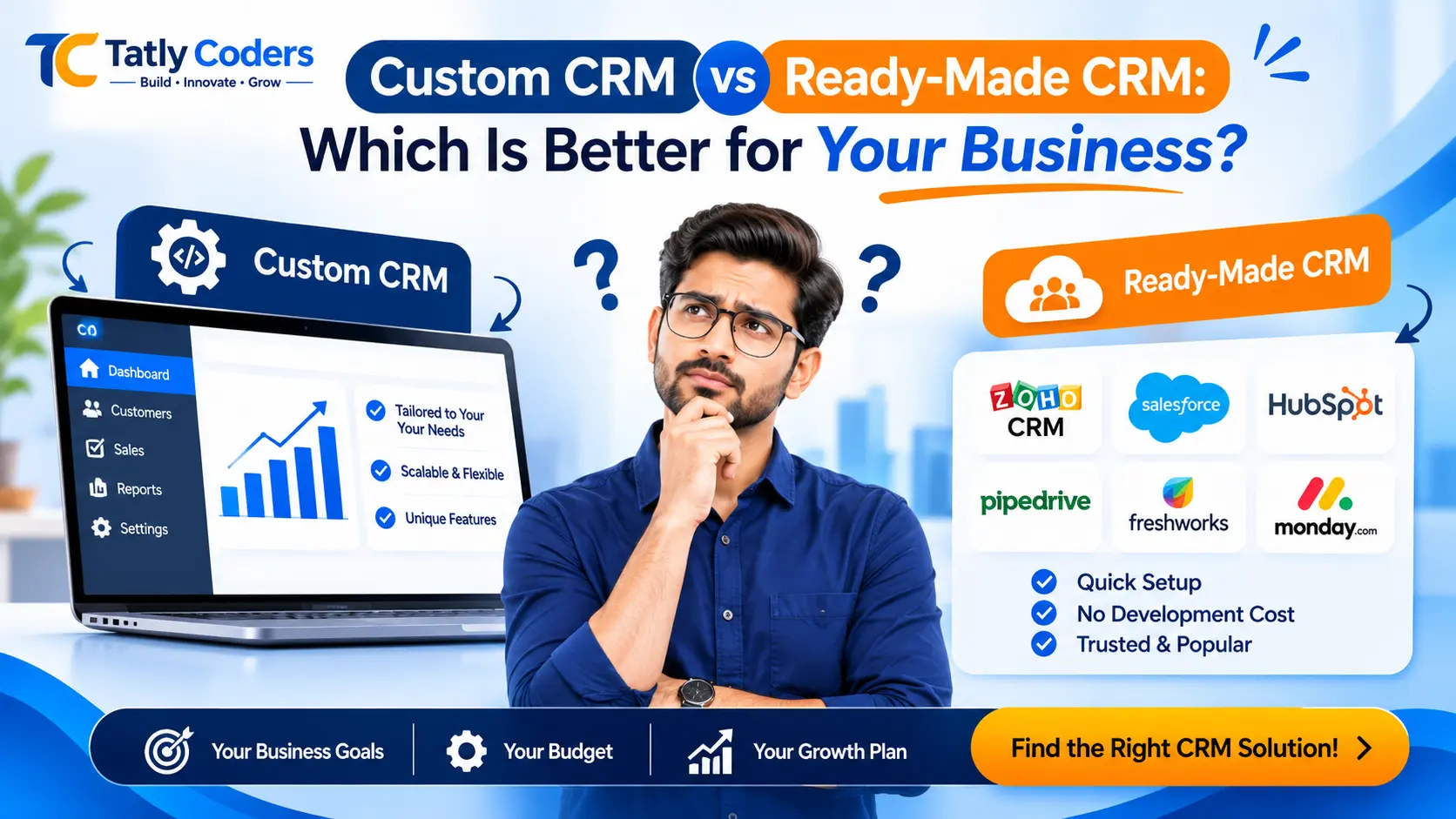
Choosing the right CRM software is an important decision for businesses that want to manage customer relationships, improve sales processes and organize daily operations. When exploring CRM solutions, business owners generally have two options: custom CRM software and ready-made CRM software. Both solutions offer different features, pricing structures and customization possibilities. In this guide, we compare custom CRM vs ready-made CRM to help you understand their differences and choose the right solution for your business requirements.
What Is Custom CRM Software?
Custom CRM software is a customer relationship management system developed specifically according to a business's unique requirements, workflows and operational processes. Unlike standard CRM platforms, a custom CRM solution allows businesses to select the features, functionalities and integrations they actually need.
For example, a real estate company may require property enquiry management, customer follow-ups, site visit scheduling and sales tracking. A healthcare organization may need patient enquiry management, appointment communication and customer records. Custom CRM development makes it possible to create solutions that support these different business requirements.
Key Features of Custom CRM Software
- Customized dashboards: Display important business information according to employee roles and responsibilities.
- Lead management: Capture, assign and track customer enquiries through customized workflows.
- Sales pipeline management: Manage opportunities and sales activities according to your business process.
- Workflow automation: Automate repetitive tasks, notifications, reminders and follow-up activities.
- Third-party integrations: Connect the CRM with websites, payment gateways, email platforms and other business applications through supported integrations.
- Role-based permissions: Control access to customer information and business operations.
- Custom reporting: Generate reports based on specific business requirements.
What Is Ready-Made CRM Software?
Ready-made CRM software is a pre-developed customer relationship management platform that businesses can purchase or subscribe to and start using with minimal initial development. These platforms generally provide standard features such as contact management, lead tracking, sales pipelines, reporting and customer communication.
Ready-made CRM solutions are suitable for businesses that want to implement a customer management system quickly without developing an application from scratch.
Key Features of Ready-Made CRM Software
- Pre-built functionality: Access standard CRM features without requiring custom software development.
- Contact management: Store and organize customer information in one platform.
- Sales tracking: Monitor leads, opportunities and sales activities.
- Task management: Schedule activities, reminders and customer follow-ups.
- Standard reporting: View available sales reports and performance information.
- Third-party integrations: Connect with supported applications and services.
- Subscription plans: Choose from available pricing packages based on users and features.
Custom CRM vs Ready-Made CRM: Key Differences
Both CRM solutions help businesses manage customer relationships, but their development approaches, flexibility, implementation time and pricing structures are different. Let's compare the major differences.
| Comparison Factor | Custom CRM Software | Ready-Made CRM Software |
|---|---|---|
| Development | Developed according to specific business requirements. | Already developed and available for implementation. |
| Customization | Features and workflows can be tailored to business needs. | Customization depends on the platform and subscription plan. |
| Implementation Time | Requires planning, development and testing. | Generally faster to set up and start using. |
| Initial Cost | Usually requires an upfront development investment. | Often starts with a subscription or licensing fee. |
| Ongoing Cost | Includes hosting, maintenance, updates and support as agreed. | May include recurring subscriptions, add-ons and additional user charges. |
| Integrations | Can be designed around specific business integration requirements. | Limited to supported integrations and available APIs. |
| Scalability | Can be designed to support future business requirements. | Depends on platform capabilities and available plans. |
| Data and Ownership | Ownership and access rights depend on the development agreement and hosting arrangement. | Data management and platform control depend on the provider's policies and contract. |
| Maintenance | Requires an agreed maintenance and update process. | Core platform maintenance is generally managed by the provider. |
| Business Flexibility | Suitable for specialized workflows and unique business processes. | Suitable for businesses whose requirements match standard CRM functionality. |
Advantages of Custom CRM Software
Custom CRM development provides businesses with the flexibility to build a customer management system around their specific operational requirements. Here are some important advantages.
1. Designed Around Your Business Requirements
Every business has different customer management processes. Custom CRM software allows companies to develop features and workflows that match their actual operations instead of adjusting every process to fit a predefined platform.
2. Greater Customization Flexibility
Businesses can choose dashboards, modules, reports, user roles and automation features according to their requirements. This makes it easier to develop a CRM system that supports specific business activities.
3. Business-Specific Integrations
A custom CRM solution can be developed to integrate with the applications and services a business already uses. This may include website enquiry forms, payment systems, email services, accounting software and other business platforms.
4. Better Control Over Development
Businesses can define the application's functionality, development priorities and future improvements. The actual level of control depends on the agreed source code, intellectual property, hosting and maintenance arrangements.
5. Flexible Future Development
As a business grows, new requirements may emerge. A properly designed custom CRM application can be extended with additional modules and features when required.
Advantages of Ready-Made CRM Software
Ready-made CRM platforms offer several benefits, especially for businesses that want to organize customer information and sales activities without investing in custom development.
1. Faster Implementation
Since the software is already developed, businesses can generally configure the platform, add users and start managing customer information more quickly.
2. Lower Initial Investment
Many ready-made CRM platforms provide subscription-based pricing, which can reduce the initial investment compared with building a complete custom CRM application.
3. Built-In Features
Ready-made CRM solutions generally include standard functionality such as contact management, lead tracking, task reminders and sales reporting.
4. Provider-Managed Maintenance
For hosted CRM platforms, the provider generally manages core software updates, infrastructure and platform maintenance according to the subscription agreement.
5. Easier Initial Setup
Businesses can often configure existing modules and user permissions without requiring a dedicated software development team.
Custom CRM vs Ready-Made CRM: Which Is More Cost-Effective?
Cost is one of the most important factors when selecting CRM software. However, businesses should not compare only the initial price. It is important to evaluate the total cost of ownership, including subscriptions, development, integrations, maintenance and future requirements.
| Cost Factor | Custom CRM | Ready-Made CRM |
|---|---|---|
| Initial Investment | Generally higher because of development requirements. | Often lower with subscription-based entry plans. |
| Monthly Subscription | May not require a per-user software subscription, depending on the hosting and licensing model. | Often charged monthly or annually. |
| Customization | Included in the agreed development scope or charged separately for additional work. | May require higher subscription plans or paid add-ons. |
| Maintenance | Requires a separate maintenance arrangement. | Core platform maintenance is generally handled by the provider. |
| Long-Term Cost | Depends on development investment, hosting, support and future enhancements. | Depends on subscriptions, users, add-ons and plan upgrades. |
Important: A custom CRM is not automatically cheaper than ready-made software over the long term. The right financial decision depends on the number of users, required functionality, subscription costs and expected business growth.
When Should You Choose Custom CRM Software?
Custom CRM development may be the right option when your business has specialized requirements that standard CRM platforms cannot efficiently support.
- Your business follows unique customer management workflows.
- You need customized sales and lead management processes.
- You require integrations with specific internal applications.
- You want dashboards and reports designed around your business operations.
- Your business requires industry-specific CRM functionality.
- You need greater control over future software development and enhancements.
When Should You Choose Ready-Made CRM Software?
Ready-made CRM software can be a suitable choice when your business requirements are relatively standard and you want to implement a solution quickly.
- You need basic customer and contact management features.
- Your business wants to start managing leads immediately.
- You have a limited initial software development budget.
- Your team can work with predefined CRM workflows.
- You do not require extensive customization or specialized integrations.
- You prefer a provider-managed CRM platform with subscription-based pricing.
Which CRM Solution Is Better for Different Industries?
The right CRM solution also depends on the industry in which your business operates. Different industries have different customer management requirements.
1. Real Estate Businesses
Real estate companies may need property enquiry management, lead assignment, site visit scheduling, sales tracking and customer follow-ups. A custom CRM can be useful when these workflows require specialized features.
2. Healthcare Organizations
Healthcare businesses may need appointment enquiries, patient communication and service management features. Any CRM used in healthcare should also be designed with appropriate privacy, security and regulatory requirements in mind.
3. Educational Institutions
Schools, colleges and training institutes can use CRM systems to manage student enquiries, admission follow-ups, counselling activities and communication with parents.
4. Retail Businesses
Retail companies may use CRM software to organize customer profiles, purchase history, customer enquiries and promotional communication.
5. IT and Software Companies
IT companies can use CRM applications to manage project enquiries, sales leads, client communication, quotations and business opportunities.
Important Factors to Consider Before Choosing a CRM
Before investing in a CRM solution, evaluate your current business processes and future requirements. Consider these important factors:
- Business requirements: Identify the customer management problems you want to solve.
- Number of users: Estimate how many employees will access the CRM system.
- Required features: List essential modules such as lead management, sales tracking and reporting.
- Integration requirements: Identify the websites, applications and third-party services that need to connect with the CRM.
- Data security: Review access permissions, backup arrangements, data protection and security policies.
- Budget: Compare the initial and recurring costs of different CRM solutions.
- Future scalability: Consider how your CRM requirements may change as the business grows.
Custom CRM Software Development Services at Tatly Coders
At Tatly Coders, we understand that every business has different customer management requirements. A standard CRM platform may work well for some companies, while others may need a more flexible solution designed around their internal business processes.
We provide website development and custom software development solutions to help businesses build digital applications according to their requirements. Our team can help plan CRM functionality such as customer management, lead tracking, sales pipeline management, automated follow-ups, reporting and third-party integrations.
Whether you are a startup, small business or growing organization, we can help you evaluate your CRM requirements and explore a suitable development approach.
If you are planning to build a custom CRM application, explore our website and software development services or contact our team to discuss your project requirements.
Frequently Asked Questions
1. What is the difference between custom CRM and ready-made CRM?
Custom CRM software is developed according to specific business requirements, while ready-made CRM software is a pre-built platform that businesses can configure and use. Custom CRM offers greater flexibility, whereas ready-made CRM generally provides faster implementation.
2. Is custom CRM software better than ready-made CRM?
Custom CRM software may be better for businesses with specialized workflows, unique integrations and specific reporting requirements. Ready-made CRM can be more suitable for businesses that need standard customer management features and quick implementation.
3. Is ready-made CRM software suitable for small businesses?
Yes. Ready-made CRM software can be a good starting point for small businesses that need basic lead management, customer records, sales tracking and follow-up reminders without investing in custom development.
4. How much does custom CRM software development cost?
The cost depends on application complexity, required modules, integrations, user roles, security requirements and development time. A detailed project assessment is recommended before preparing a development quotation.
5. Can custom CRM software integrate with an existing website?
Yes. Custom CRM software can be integrated with an existing business website using APIs, form integrations and other supported communication methods. This can help transfer website enquiries directly into the CRM system.
6. Can ready-made CRM software be customized?
Many ready-made CRM platforms support customization through settings, workflows, extensions, APIs and available development tools. However, the level of customization depends on the platform and subscription plan.
7. Which CRM is better for a growing business?
The right option depends on the business's current requirements and future plans. Ready-made CRM may be sufficient when standard features meet business needs. Custom CRM may be more suitable when specialized workflows and integrations become important.
8. How long does it take to develop custom CRM software?
The development timeline depends on the number of modules, application complexity, integrations, testing and project requirements. A basic CRM application may take less time than a complex enterprise-level CRM system.
Conclusion
Both custom CRM and ready-made CRM software offer valuable benefits for businesses looking to improve customer management and sales operations. Ready-made CRM solutions provide faster implementation and access to standard features, while custom CRM development offers greater flexibility for specialized business requirements.
Before making a decision, evaluate your business processes, budget, required integrations, number of users and long-term goals. Choosing the right CRM solution can help improve operational efficiency and support sustainable business growth.
Looking for a CRM solution designed around your business requirements? Contact Tatly Coders to discuss your custom CRM software development project and explore the right approach for your business.